Before the term “growth hacking” went mainstream, many non‑technical founders felt shut out by jargon and code‑heavy tactics. The good news: modern no‑code tools and a disciplined testing process have made growth achievable without writing a single line of code. This guide shows you how to run 10+ experiments a week ethically, measure what matters, and scale what works—no engineering sprint required.
What Growth Hacking Really Is (And Isn’t)
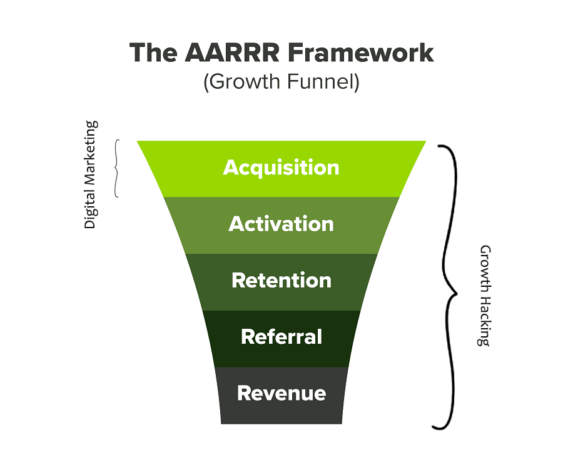
Growth hacking is a repeatable process for finding, testing, and scaling the highest‑impact opportunities across the AARRR funnel (Acquisition, Activation, Retention, Revenue, Referral). Unlike broad “brand marketing”, growth work is laser‑focused on a metric target, a hypothesis, and an experiment that can be run quickly and evaluated with data.
Key Differences From Traditional Marketing
- Objective: growth focuses on compounding metrics (e.g., activation rate, LTV:CAC), not just awareness or impressions.
- Tempo: rapid sprints over long planning cycles; small, testable changes beat big launches.
- Tooling: lightweight, often no‑code tools and native platform features before heavy builds.
- Scope: full‑funnel, not just top‑of‑funnel media.
The MASS Framework for Non-Technical Founders
Use this 4‑step loop to ship measurable experiments every week:
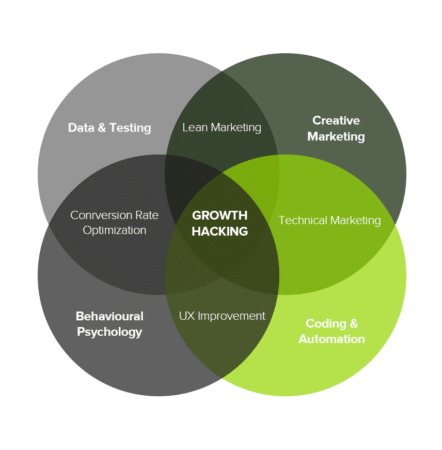
- Map: Identify cross‑platform features you can exploit without code (feeds, DMs, groups, live streams, UGC, lead forms, pixels, lookalikes).
- Assemble: Build a minimal, no‑code stack to create, publish, track, and iterate.
- Sprint: Prioritize ideas with ICE scoring (Impact, Confidence, Effort) and run 1–2 week experiments with clear hypotheses.
- Scale: Keep only winners; expand budgets, audiences, and surfaces; templatize assets.
Suggested No-Code Stack (Safe and Widely Used)
- Research and ideation: BuzzSumo (content research), AlsoAsked and AnswerThePublic (questions), Google Trends.
- Asset creation: Canva or Figma (creatives), CapCut or Descript (video), Wordtune or Grammarly (copy polish), WordSwag (fast text‑on‑image for mobile).
- Publishing and automation: Buffer or Hootsuite (scheduling), Zapier or Make (automation), Typeform (lead capture), Webflow or Notion (landing pages).
- Analytics: Google Analytics, Mixpanel or Amplitude (product), Looker Studio (dashboards), Meta/LinkedIn/Twitter native analytics.
- Experiment tracking: Airtable or Notion with a simple ICE and results template. Also, GrowthOS by growthhackers.com
How to Write Great Experiments (Template)
- Hypothesis: If we [change], then [metric] will improve because [insight].
- Metric and target: One primary metric (e.g., Activation rate +15%).
- Scope: Channel, audience, asset, offer, timeframe (7–14 days).
- Guardrails: Budget cap, frequency cap, brand, and policy checks.
- Decision rule: Keep if the target is met with statistical confidence or a strong directional lift and an acceptable CAC; otherwise, kill or iterate.
Three No-Code Playbooks You Can Launch This Week
1) Social proof retargeting loop
- Goal: Lift activation (trial start, demo request) using UGC and testimonials.
- Steps:
- Collect 5–10 short testimonials or UGC clips. If you lack them, run a 10‑customer interview sprint or a micro‑survey (Typeform). Ask for concrete outcomes and permission.
- Build 3–5 creative variations in Canva: quote cards, 15‑second vertical videos, before/after.
- Install the Meta pixel and set up a retargeting audience of site visitors in the last 30 days.
- Launch A/B tests with different headlines, social proof types (logos, numbers, quotes), and CTAs.
- Target: +20% lift in activation vs. baseline within 14 days.
- Why it works: Social proof reduces perceived risk. Nielsen reports 88% of consumers trust recommendations from people they know; testimonial‑style ads harness that trust.
2) Content remix engine
- Goal: Increase top‑of‑funnel qualified traffic without new long‑form creation.
- Steps:
- Take one pillar article or webinar and atomize it into 12 assets: 4 quote cards, 3 short clips, 3 carousels, 1 checklist, 1 email.
- Schedule across LinkedIn, X (Twitter), Instagram, and YouTube Shorts with platform‑native hooks.
- Pair with a simple lead magnet (1‑page checklist) on a Notion/Webflow page plus an email capture form.
- KPI: 3–5% landing page CVR and <$3 content‑to‑lead cost in 2 weeks.
- Why it works: Consistent surface area beats sporadic “big” posts; repurposing multiplies touchpoints while keeping production light.
3) Community insight to offer‑test
- Goal: Improve offer‑message fit by harvesting real questions and objections.
- Steps:
- Use native search in Facebook Groups, LinkedIn Groups, Reddit, and Twitter Advanced Search to find threads with your core problem keywords. Avoid unofficial scraping tools that violate platform policies.
- Tag patterns: objections, desired outcomes, budget signals, competing tools.
- Draft 3 offer angles using the language you captured. Example: “Cut customer onboarding time by 35% without adding headcount.”
- Run a $100 micro‑test per angle with Meta Lead Ads to gauge CTR and cost per lead; the winner graduates to a larger test.
- Why it works: Voice‑of‑customer language outperforms brand speak; even small paid tests generate a faster signal than debates.
Metrics That Matter by Funnel Stage (AARRR)
- Acquisition: CTR, CPC, cost per lead, qualified visit rate.
- Activation: Activation rate, time‑to‑value, demo show‑up rate.
- Retention: Day‑7/30 retention, WAU/MAU ratio, feature adoption.
- Revenue: Paid conversion rate, ARPU, gross margin, LTV.
- Referral: K‑factor, invite rate, referral conversion rate.
Simple Finance Guardrails
- CAC to LTV: Aim for LTV:CAC of 3:1 or better; adjust for payback period.
- Payback period: Target <3–6 months for SMB SaaS; adjust for your model.
- Budgeting sprints: Start with a 70/20/10 split (70% proven, 20% promising, 10% wildcards).
A 30-Day No-Code Growth Calendar
Week 1: Instrumentation check (pixels, events), set up your Notion/Airtable experiment tracker, backlog 20 ideas, and score with ICE.
Week 2: Launch 3 experiments (one per playbook), daily checks, pause losers.
Week 3: Iterate creatives and audiences for the top 1–2 performers; ship a lightweight onboarding improvement (email nudge or checklist).
Week 4: Scale the winner (budget x2), archive learnings, and add 10 fresh ideas to the backlog.
Legal, Ethical, and Brand-Safety Notes
Copyright: Use licensed or royalty‑free assets. Popular libraries include Unsplash and Pexels for images, and Artlist or Epidemic Sound for music. Always review license terms.
Platform policies: Respect ad and API policies; avoid data scraping extensions that violate terms.
Privacy: Honor consent and local laws (e.g., GDPR/CCPA) in analytics and email capture.
Accessibility: Add captions to the video, proper contrast, and alt text to improve reach and compliance.
Brief Case Studies and Evidence (All-Time Classic)
Dropbox referrals: The two‑sided referral program drove reported 3,900% growth in 15 months by incentivizing both inviters and invitees. Source: Sean Ellis and numerous public interviews by Drew Houston.
Hotmail PS line: Adding “P.S. I love you. Get your free email at Hotmail” to outbound emails helped the service reach 1M users in 6 months, 12M in 18 months. Source: Harvard Business Review and venture case archives.
Notion community: Notion’s ambassador‑driven community and template marketplace accelerated self‑serve adoption with minimal paid spend. Source: company interviews and public community programs.
Common Pitfalls (And Fixes)
Chasing virality: Replace “go viral” goals with specific funnel metrics and time‑boxed hypotheses.
Tool bloat: Cap your stack to one tool per job; revisit quarterly.
Broad targeting: Start narrow (intent, lookalikes of converters) before broad expansion.
Skipping onboarding: Activation lifts often beat acquisition; invest in first‑run checklists, product tours, and triggered emails.
FAQs From Non-Technical Founders
Not for the playbooks above. You can get far with native features and no‑code tools; bring in engineering once you’ve proven a winning loop that merits a build.
3–5 tightly scoped tests are better than 20 unfocused ones. Aim for an end‑to‑end weekly cadence: ship on Monday, learn mid‑week, decide Friday.
For paid social tests, a payback under 3–6 months or a path to 3:1 LTV:CAC at scale is a healthy signal.
After you hit your target metric for two consecutive sprints and your unit economics hold within guardrails.
[elementor-template id="83210"]