Why spending blindly on Social Media won’t do the trick for you.
I’m going to start by making the assumption that your company/organization maintains a decent presence on the most popular Social Media platforms (Facebook, Twitter, Instagram, Snapchat, etc.). Then I’m going to turn this into a question, and ask: “Why are you maintaining a Social Media presence?” For a lot of companies, the answer is because everybody else is doing it. Yes, Social Media is the new Black of our era.
However, there is one clear trap here. By diving into Social Media without a clear strategy and tracking of your actions, it’s really difficult to determine whether or not anything you’re doing is working (calculate your Return on Investment - ROI).
For a lot of companies, the answer is because everybody else is doing it. Yes, Social Media is the new Black of our era.
However, there is one clear trap here. By diving into Social Media without a clear strategy and tracking of your actions, it’s really difficult to determine whether or not anything you’re doing is working (calculate your Return on Investment - ROI).
Step 1: Figure out what Social Media platforms to use
So, the first thing you need to do is figure out which platforms to invest your time and money on. Unfortunately, there’s no one-answer-fits-all case for you here. It all depends on the media your target audience and potential customer base is on. For example, if you’re going to target 13 - 25 years old in the US, you should probably go for Snapchat and Musical.ly. At this point I can almost visualize the bubble over your head saying “How safe is it spending money and effort on a platform that might not be around in 6 months?”. I am going to paraphrase Gary Vaynerchuk here, and tell you that it doesn’t really matter what service is going to be around in 6 months or a year from now. Spending on one platform today, doesn’t prevent you from switching your attention into a different platform the next day.
When Facebook is #1, you run advertising on it. When it becomes #4, you run less. It is that simple. Figure out what works for you and go full on.After tackling the issue of what platforms to use, comes the big question: How do we measure the ROI on Social Media?
Step 2: Defining Social Media ROI
I’m going to use Joe GrowthChild (fictional character) as an example to make the topic more clear. Joe has an online store selling toys for children and spends $1000/month advertising on Facebook. Every month, around $1800 worth of sales come from Facebook. Things seem to be pretty easy for Joe, as he can use the formula below to calculate his Social Media ROI.Social media ROI = (return – investment) / investment
It is a simple formula and it’s not a new one. Analysts have been using it for years to calculate return on investment on stocks, property, etc. In Joe’s case, the math would go like this: Social Media ROI = (1800 - 1000) / 1000 = 80%. While calculating Social Media ROI seems like a straightforward process, this is not the case in real life.
“There’s a hope that the ever- evasive ROI formula will finally be revealed in a flash of blinding light, paving the way for continued investments into social media. Keep dreaming.” - Forbes
Step 3: Define your goals
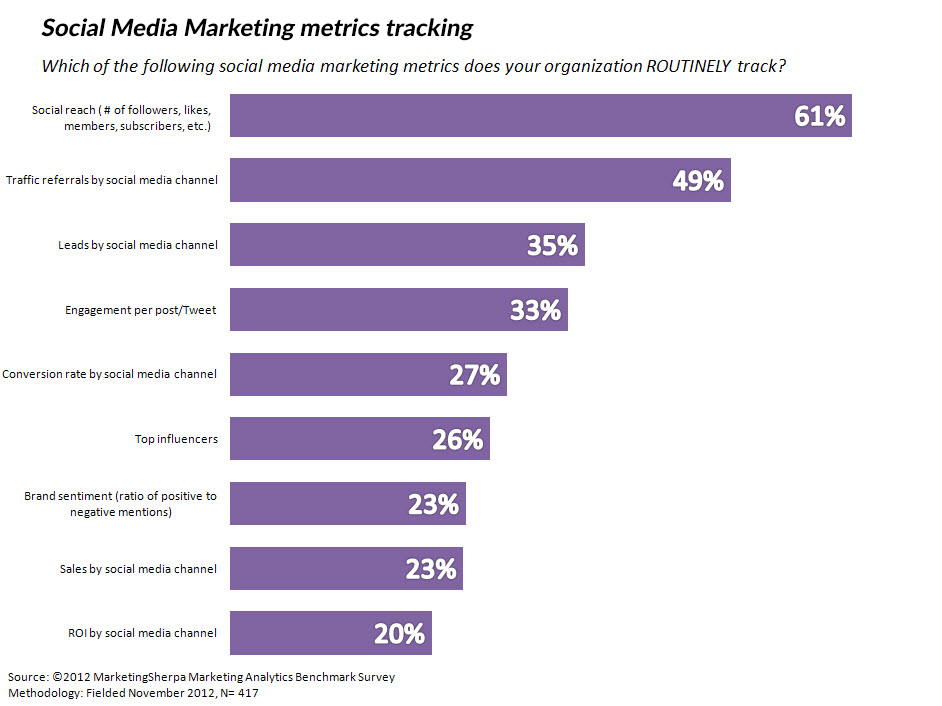
It all comes down to defining your goals. What is it that you want to achieve out of your Social Media presence? Sales, views (aka impressions), leads, high engagement with your community? You name it. Having clear and specific goals (or your Key Performance Indicators) makes it easier to keep track of your actions and determine whether what you are doing is effective or not. All of your goals should be quantifiable and linked to a campaign. They should be things that you can attach a number to, and count. Here are some important metrics you should track, from our friends at Buffer:- Leads = potential customers and anyone with the need or interest to use your product or service.
- Engagement = the total number of likes, shares, and comments on a post.
- Reach = the amount of people that your social media posts reach.
- Impressions = how many people saw your post.
- Funnels = the paths that visitors take toward converting.
- Bounce rate = the rate at which people leave your site after viewing only one page.
- Inbound links = the number of sites linking back to your website or page.
Step 4: Assign a value to every action
After defining your goals, you have to define the actions you take on Social Media that lead towards the achievement of your goals, and assign a value to them. Each action requires a particular amount of effort (like money and time) invested to happen. How much does it really cost to get a new Facebook like, Twitter follower, Instagram like, etc.? Spending $5/day on Facebook Ads will buy you around 9 Likes per day according to Buffer’s blog. Going back to our ROI formula, what would you say is the investment made over a period of 5 days in this case?
If you just shouted “5*5 = $25” in your head, well, you’re wrong.
In fact, even such a calculated and seemingly simple action like running Facebook Ads for 5 days, can be broken down into many sub tasks or actions for which calculating the exact monetary value is not as straightforward.
[clickToTweet tweet="How much does it really cost to get a new Facebook like, Twitter follower, Instagram like, etc.?" quote="How much does it really cost to get a new Facebook like, Twitter follower, Instagram like, etc.?"]
Remember the example with Joe?
Here’s a list of the standard costs required in order to run his ads:
Spending $5/day on Facebook Ads will buy you around 9 Likes per day according to Buffer’s blog. Going back to our ROI formula, what would you say is the investment made over a period of 5 days in this case?
If you just shouted “5*5 = $25” in your head, well, you’re wrong.
In fact, even such a calculated and seemingly simple action like running Facebook Ads for 5 days, can be broken down into many sub tasks or actions for which calculating the exact monetary value is not as straightforward.
[clickToTweet tweet="How much does it really cost to get a new Facebook like, Twitter follower, Instagram like, etc.?" quote="How much does it really cost to get a new Facebook like, Twitter follower, Instagram like, etc.?"]
Remember the example with Joe?
Here’s a list of the standard costs required in order to run his ads:
- Man-hours: Whether you’re going solo, or you have a social media team, add up the man-hours that go into a specific social media marketing campaign over a specified period of time. Don’t just use an employee’s annual salary, because they’re more than likely going to be working on several projects throughout the year. Measure this investment per-campaign.
- Content: Did you get a landing page written by a professional copywriter? Or maybe you outsourced status updates. These costs are easy to overlook, but they count.
- Ad costs: If you’re running Facebook Ads, boosting a post on Facebook , or running an ad on Instagram, add in that cost as well.
- Social Media tools: Using Facebook and Twitter is free, but if you’re using a tool like Sprout Social or other social media management software, you need to add those costs in.
Step 5: What tools to use
There is a variety of social media analytics tools available to help you keep track of the diverse metrics you might be after. Keep reading to find out some of the highlights: One of the easiest ways to track your Social Media campaigns and goals is through Google Analytics. Look for the section “Conversions”, and set up a new goal.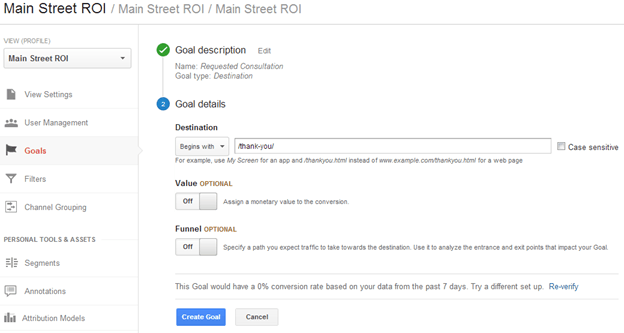 Once you are familiar with it, you can try some more advanced tools as well, like Moz, KISSmetrics, Hootsuite, Buffer and Sprout Social.
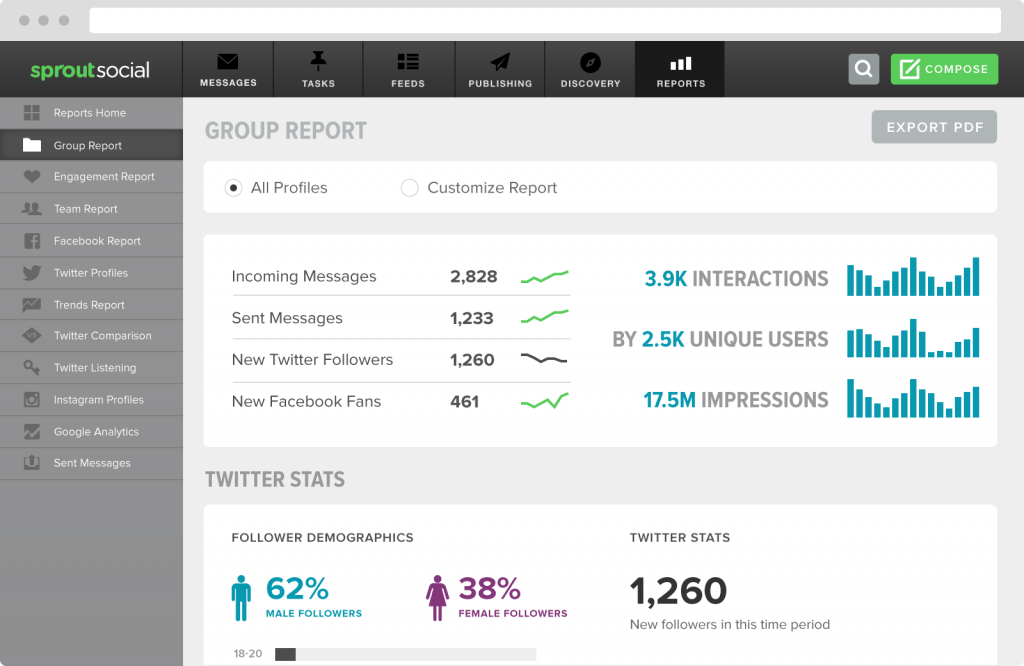 There are also specific tools integrated into each platform, like Facebook Insights and Twitter Analytics that are totally free and able to provide you with a great depth of information on your goals and actions. However, one disadvantage of using this kind of tools, is missing the 360 view of your entire Social Media presence.
For better results, try using a combination of the built-in tools together with some tools that offer cross-platform analytics.
There are also specific tools integrated into each platform, like Facebook Insights and Twitter Analytics that are totally free and able to provide you with a great depth of information on your goals and actions. However, one disadvantage of using this kind of tools, is missing the 360 view of your entire Social Media presence.
For better results, try using a combination of the built-in tools together with some tools that offer cross-platform analytics.